
Therapy
Caries treatment of any complexity, restoration and rebuilding of teeth.
Boris SP clinic · Brovary
A permanent team and a dedicated specialist for every field. We treat thoroughly and without rushing - so you come back for a check-up, not a redo.

We care about our patients' health and beautiful smile, applying the best of modern dentistry for effective and safe treatment.
Everything good has its price. When planning treatment we offer several ways to solve the same problem - whether it's a filling or a crown. The best materials and methods cost more, but alongside the best there is also the good: we agree on the method and cost with the patient whenever medical indications allow. Every job, regardless of its price, is done professionally and to accepted standards.
Full-cycle treatment - from prevention to implants.
Caries treatment of any complexity, restoration and rebuilding of teeth.
Root canal treatment of any complexity - careful, thorough and reliable.
Paediatric dentist in Brovary: gentle adaptation, no pain or fear, careful with milk teeth.
Crowns and dentures: metal-ceramic, zirconia, clasp and flexible dentures. Made promptly.
Gum treatment, calculus removal, professional hygiene and tooth splinting.
Remineralisation, fissure sealing, protection from caries and sensitivity.
Teeth cleaning and whitening in Brovary - in-office and at-home, visible result.
Implant dentist: Osstem implants, sinus lift, crowns on implants.
We've treated the people of Brovary for over twenty years. You can't buy a reputation like that - you can only earn it, and we have.
We have no staff churn. You see a doctor who remembers you and your history, not one meeting you through a chart each time.
Therapy, prosthetics, surgery and paediatric care are each handled by a different doctor. Everyone does what they're genuinely good at.
We deliberately see fewer patients a day. That time goes into doing it carefully and once, not quickly and then redoing it.
A well-run lab workflow: fewer visits and fewer weeks living with a temporary. The work is ready when promised.
An exam, an honest talk about options and cost - and only then the work. You know what you're paying for before you're in the chair.

prosthodontist, first category
Graduated from the Bogomolets National Medical University in 1989. 29 years of experience. Has repeatedly attended training to improve his dental skills. Participant of international conferences and exhibitions.

dentist, first category
Graduated from the Bogomolets National Medical University in 1989. 29 years of experience. Has repeatedly attended training to improve her dental skills. Participant of international conferences and exhibitions.

dentist, first category
Graduated from the Gorky Donetsk National Medical University in 2000. 18 years of experience. Has repeatedly attended training to improve her dental skills. An active participant of conferences and exhibitions.

dentist, first category

dentist, first category
Current clinic price list. The exact cost is set by the doctor after an examination and treatment plan.
Prices valid as of 25.06.2026
| Disinfection and sterilisation supplies (per visit) | 150 UAH |
| Consultation | 300 UAH |
| Consultation with a detailed treatment plan and cost estimate | 500 UAH |
| Anaesthesia — computerised | 450 UAH |
| Anaesthesia — conduction | 300 UAH |
| Anaesthesia — topical (on gums) | 50 UAH |
| Additional anaesthetic carpule | 100 UAH |
| Hygiene lesson | 300 UAH |
| Professional oral hygiene | 1100 UAH |
| Removal of hard dental deposits from one jaw (stage 1) | 650 UAH |
| Removal of massive sub- and supragingival deposits from one jaw (stage 2) | 750 UAH |
| Removal of supragingival deposits (first visit) | 750 UAH |
| Removal of subgingival deposits (second visit) | 650 UAH |
| Tooth splinting (per tooth) | 700 UAH |
| Remineralising coating (fluoride, calcium) for one jaw | 300 UAH |
| Fissure sealing of one tooth | 700 UAH |
| Sealing of an old filling | 1000 UAH |
| Polishing of an old filling | 300 UAH |
| Desensitiser treatment (1–3 teeth) | 200 UAH |
| Whitening of one tooth (1 session) | 1000 UAH |
| In-office teeth whitening (1 session) | 4500 UAH |
| Microabrasive whitening | 750 UAH |
| Decorative tooth elements (gem cost not included) | 1000 UAH |
| Working field isolation | 250 UAH |
| Caries, class 1 cavity — superficial, moderate | 1450 UAH |
| Caries, class 1 cavity — deep | 1550 UAH |
| Caries, class 2 cavity — superficial, moderate | 1550 UAH |
| Caries, class 2 cavity — deep | 1750 UAH |
| Caries, MOD cavity | 1950 UAH |
| Caries, class 3 cavity — superficial, moderate | 1550 UAH |
| Caries, class 3 cavity — deep | 1650 UAH |
| Caries, class 4 cavity — superficial, moderate | 1650 UAH |
| Caries, class 4 cavity — deep | 1750 UAH |
| Direct composite veneer | 2200 UAH |
| Caries, class 5 cavity — superficial, moderate | 1450 UAH |
| Caries, class 5 cavity — deep | 1650 UAH |
| Class 6 caries / pathological abrasion — superficial defect, moderate | 1450 UAH |
| Class 6 caries — deep, defect, traumatic chip | 1750 UAH |
| Closing diastemas, reshaping teeth (per tooth) | 1800 UAH |
| Rebuilding a destroyed crown for prosthetics (Build-up) | 1200 UAH |
| Lining under a filling | 400 UAH |
| Temporary filling | 150 UAH |
| Temporary cement filling | 350 UAH |
| Removal of an old filling | 50 UAH |
| Working field isolation | 250 UAH |
| Primary canal instrumentation with files (per canal) | 700 UAH |
| Repeat canal irrigation (per canal) | 400 UAH |
| Medicated dressing in canals or tooth cavity | 300 UAH |
| Temporary canal filling with calcium preparations | 550 UAH |
| Filling one canal (incisors, canines) with gutta-percha | 700 UAH |
| Filling premolars with gutta-percha | 1000 UAH |
| Filling molars with gutta-percha | 1300 UAH |
| Titanium post placement | 800 UAH |
| Fibreglass post placement | 800 UAH |
| Post removal from canal | 1000 UAH |
| Removal of an instrument fragment from canal | 1500 UAH |
| Canal unfilling | 900 UAH |
| Diagnostic treatment (canal revision) | 1200 UAH |
| Closing tooth perforation with MTA | 650 UAH |
| Visiography, primary | 100 UAH |
| Visiography, secondary | 50 UAH |
| Removal of an old filling | 50 UAH |
| Temporary filling | 150 UAH |
| Temporary cement filling | 350 UAH |
| Temporary tooth wall restoration | 300 UAH |
| Disinfection and sterilisation supplies | 150 UAH |
| Working field isolation | 250 UAH |
| Adaptation, talk with the child (30 minutes) | 500 UAH |
| Consultation | 300 UAH |
| Anaesthesia — computerised | 450 UAH |
| Anaesthesia — infiltration | 350 UAH |
| Anaesthesia — topical | 50 UAH |
| Filling for caries (moderate, superficial) | 850 UAH |
| Filling for caries (deep) | 950 UAH |
| Medicated lining | 200 UAH |
| Treatment of early caries (white spot), remineralisation (1–2 teeth) | 300 UAH |
| Medicated dressing in canals or cavity | 350 UAH |
| Canal treatment of a milk tooth | 400 UAH |
| Canal filling of a milk tooth | 350 UAH |
| Temporary filling | 150 UAH |
| Metal-ceramic crown Duceram KISS | 4000 UAH |
| Porcelain crown | 12000 UAH |
| Crown on a zirconia framework | 12000 UAH |
| Cast crown | 2000 UAH |
| Acrylic crown | 1500 UAH |
| Temporary crown | 500 UAH |
| Temporary crown made in mouth | 500 UAH |
| Temporary milled acrylic crown | 1500 UAH |
| Cast post — single-rooted | 1500 UAH |
| Cast post — multi-rooted | 1700 UAH |
| Zirconia post | 4000 UAH |
| Titanium post | 800 UAH |
| Cementing a crown/post | 300 UAH |
| Crown removal — stamped | 200 UAH |
| Crown removal — cast/metal-ceramic | 300 UAH |
| Removal of a core inlay | 1000 UAH |
| Removable plate denture Vertex Basiq 20 | 9000 UAH |
| Flexible removable dentures Acryfree | 10000 UAH |
| Removable micro-denture (1–2 teeth) Vertex Thermo Sens | 2500 UAH |
| Flexible removable dentures DentaLux | 10000 UAH |
| Clasp-retained partial denture | 15000 UAH |
| Attachment-retained partial denture | 17000 UAH |
| Attachment-retained partial denture with milling | 18000 UAH |
| Denture adjustment | 100 UAH |
| C-silicone–alginate impression | 300 UAH |
| A-silicone impression | 500 UAH |
| For bruxism | 1800 UAH |
| For at-home whitening | 1300 UAH |
| Milk tooth extraction — stage 1 | 300 UAH |
| Milk tooth extraction — stage 2 | 500 UAH |
| Permanent tooth extraction — stage 1 | 1000 UAH |
| Permanent tooth extraction — stage 2 | 1200 UAH |
| Wisdom tooth extraction | from від 1500 UAH |
| Atypical extraction with mucosal flap | 3500 UAH |
| Haemostatic sponge | 150 UAH |
| Suturing the socket after extraction | 200 UAH |
| Trimming the mucosal hood for pericoronitis | 750 UAH |
| Treatment of a periodontal pocket (one tooth) | 300 UAH |
| Abscess incision, drainage, debridement | 600 UAH |
| Crown lengthening | 300 UAH |
| Osstem implant | 12000 UAH |
| Gingival former | 2000 UAH |
| Metal-ceramic crown on an implant | 12000 UAH |
| Closed sinus lift | 5000 UAH |
A short, plain-language look at how common procedures work. Not a substitute for a dentist's examination.
Tooth decay does not start as a large black cavity. It begins with a gradual loss of minerals from the enamel. Plaque bacteria break down sugars and starches from food and release acids that damage the tooth's tissues. When acid exposure is frequent, the enamel does not have time to recover the minerals it lost. First an area of demineralization appears, then the enamel weakens and a cavity forms.
At an early stage the process can often be stopped or reversed without drilling. Once a cavity has formed, the damaged tissue has to be removed and the tooth restored with a filling.
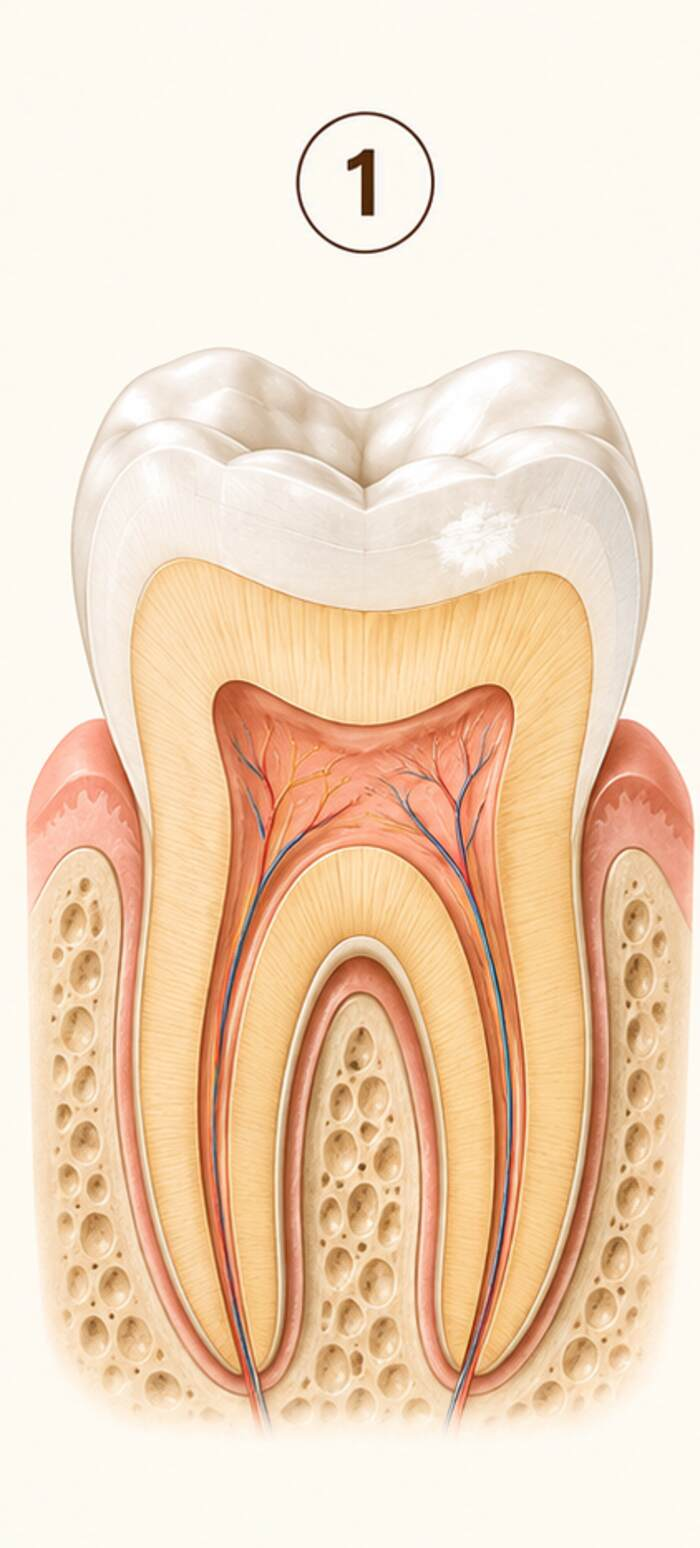
The enamel loses some of its minerals, but its surface is not yet broken. A dull white, yellowish, or brownish spot may appear on the tooth.
There is usually no pain, so early decay is often found only during a routine check-up. At this stage the process can sometimes be stopped without drilling, with professional cleaning, fluoride treatments, cutting back on frequent sugary snacks, and proper home care. The decision depends on how active the lesion is and the dentist's assessment.
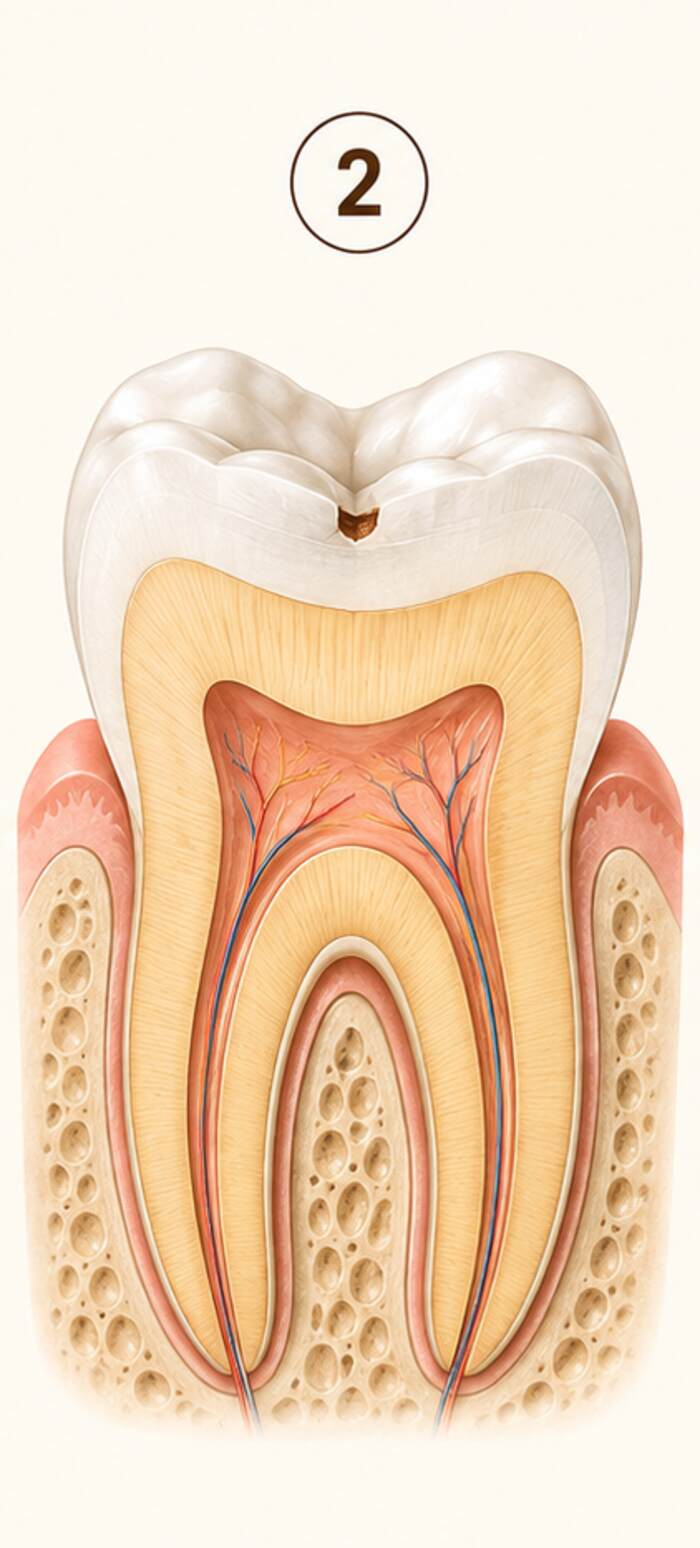
The enamel becomes brittle, its surface breaks down, and a small cavity forms. Brief sensitivity to sweet, sour, cold, or hot may appear.
A cavity like this will not heal on its own. The dentist removes the damaged tissue and restores the tooth's surface with a filling material. The smaller the cavity at the time of treatment, the more of the tooth's own tissue can be preserved.
Decay passes through the enamel and reaches the dentin. Dentin is softer than enamel and contains microscopic tubules connected to the tooth's inner tissues, so the damage starts spreading faster and can be much wider than the point visible from outside.
Sensitivity becomes more pronounced. Food sometimes gets stuck in the cavity, and an unpleasant smell or brief pain may appear. The pain usually stops once the trigger is removed, but the absence of pain does not mean the decay has stopped.

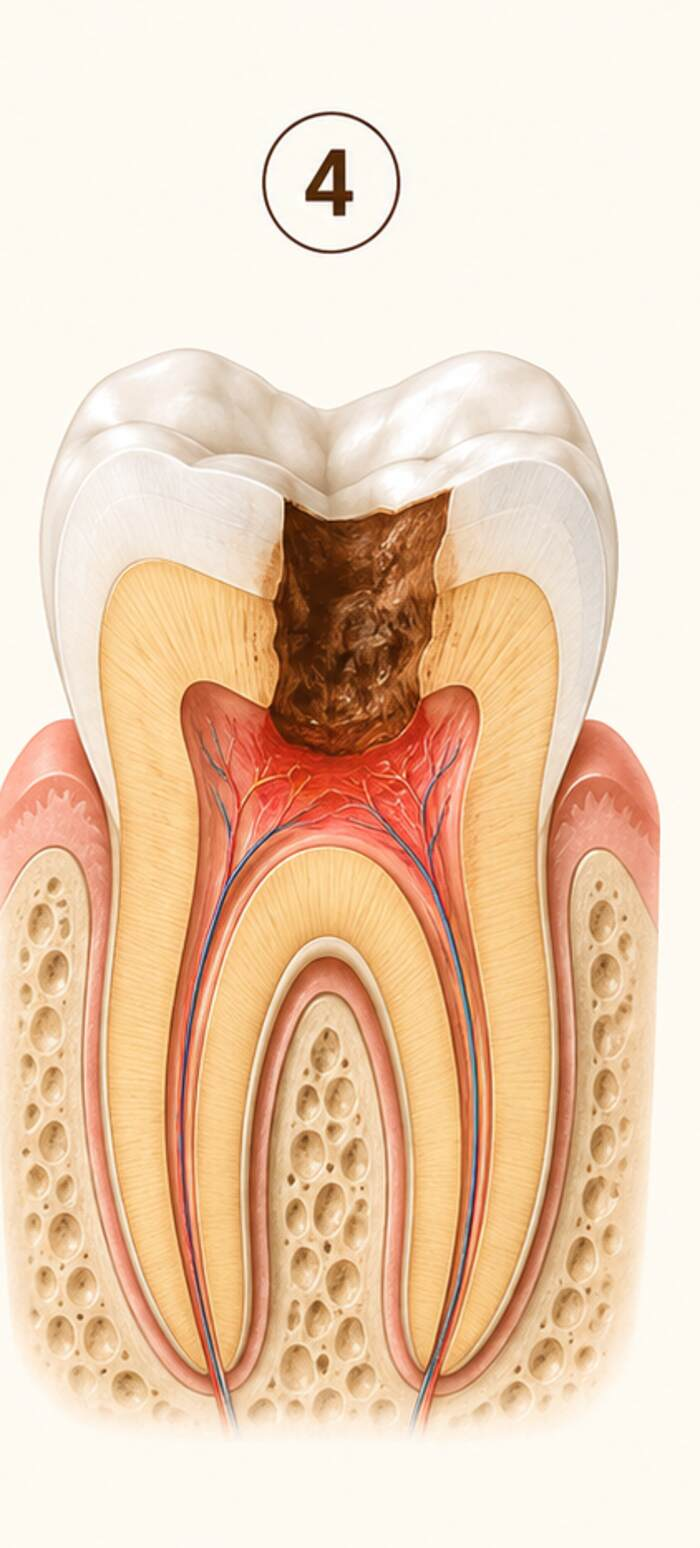
Only a thin layer of dentin remains between the cavity and the pulp. The tooth may react strongly to cold, heat, and sweets, and pain can appear when food gets into the cavity.
If the pulp is not yet irreversibly inflamed, the dentist tries to preserve it and restore the tooth with a filling, inlay, or onlay. In some cases protective materials are used to shield the pulp. If infection has already reached inside the tooth and caused irreversible inflammation or pulp death, root canal treatment may be needed.
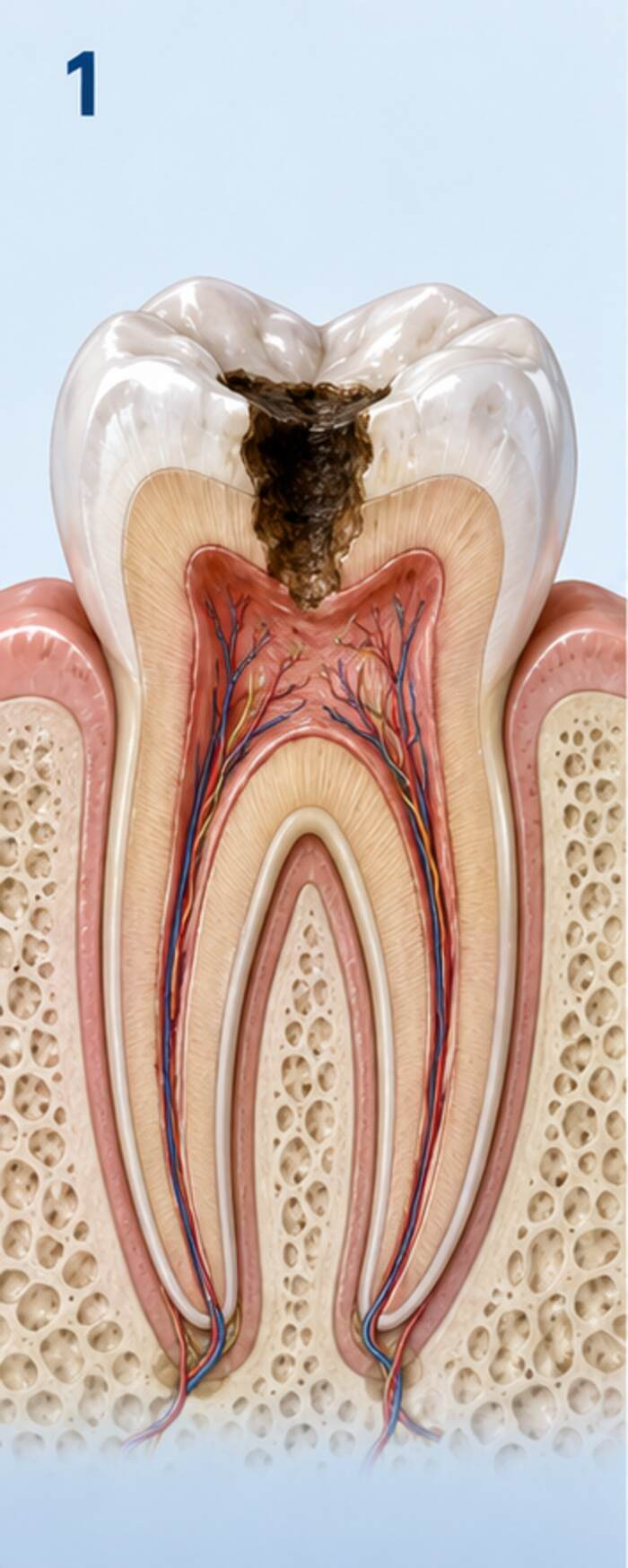
Important: the extent of the damage and the condition of the pulp cannot be reliably judged from appearance or pain alone. To diagnose it, the dentist uses an examination, sensitivity testing, tapping the tooth, and an X-ray. On the contact surfaces between neighboring teeth, decay can stay hidden for a long time without an X-ray.
Root canals themselves are not removed. What is removed is the inflamed, infected, or dead pulp inside them, after which the inner space of the tooth is mechanically cleaned, rinsed with antiseptic solutions, filled, and sealed.
Root canal treatment is needed when the pulp is irreversibly inflamed or has died. The cause can be deep decay, a crack, an injury to the tooth, a leaking old restoration, or repeated treatment of the same tooth. The goal of the procedure is to remove bacteria from the canal system, prevent reinfection, and save the natural tooth.
The dentist examines the tooth, reviews the symptoms, takes an X-ray, and checks the pulp's response to temperature or electric tests. Sensitivity to biting and tapping is also assessed. Once the diagnosis is confirmed, local anesthesia is given.
The tooth is usually isolated with a rubber dam - a thin latex or latex-free sheet. It protects the canal system from bacteria in saliva, prevents small instruments from being swallowed, and keeps rinsing solutions out of the mouth.
The dentist creates a small opening through the chewing surface of a back tooth or the inner side of a front tooth. This opens access to the pulp chamber and the canal openings.
The number and shape of canals differ between teeth, and even between people. In complex cases the dentist may use magnification, a microscope, and extra X-rays to find every branch and avoid missing a canal.
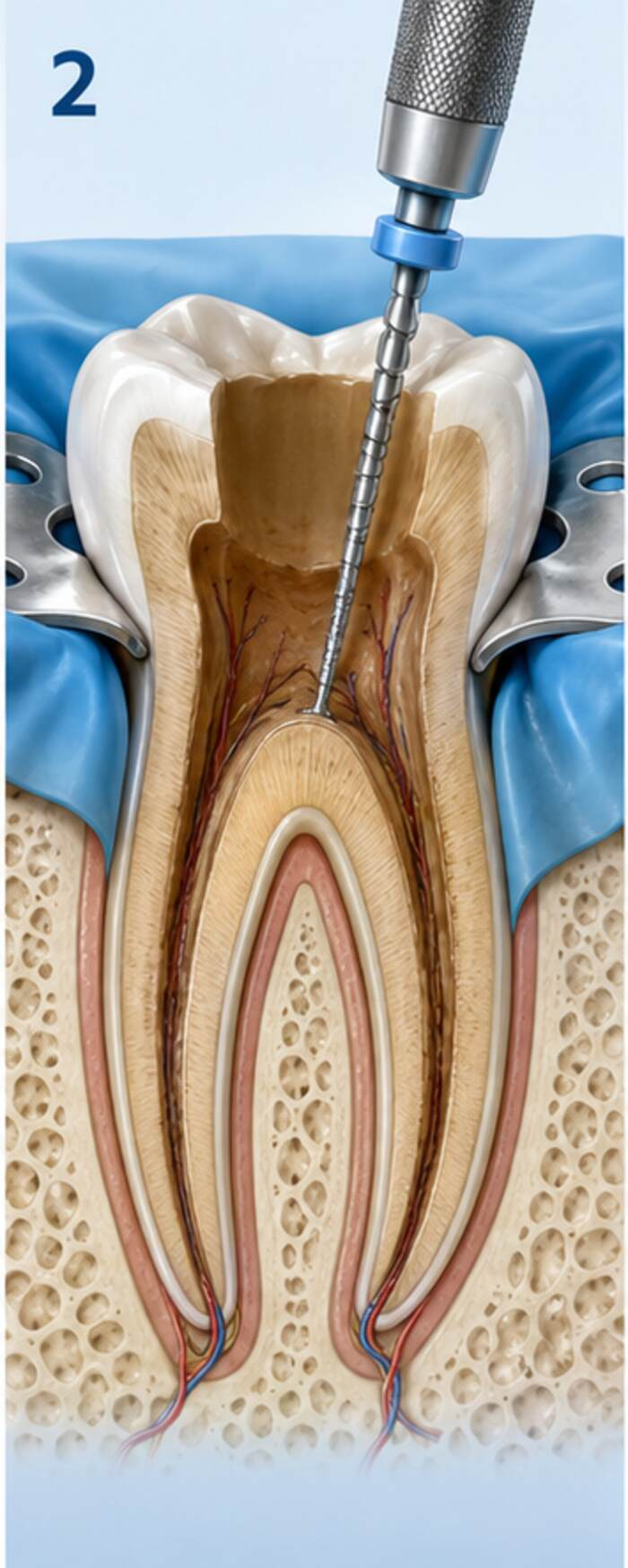
The inflamed or dead pulp is removed with thin endodontic instruments. The working length of each canal is measured with an electronic device and checked with an X-ray if needed. The dentist then cleans the canal walls and shapes them for thorough rinsing and filling.
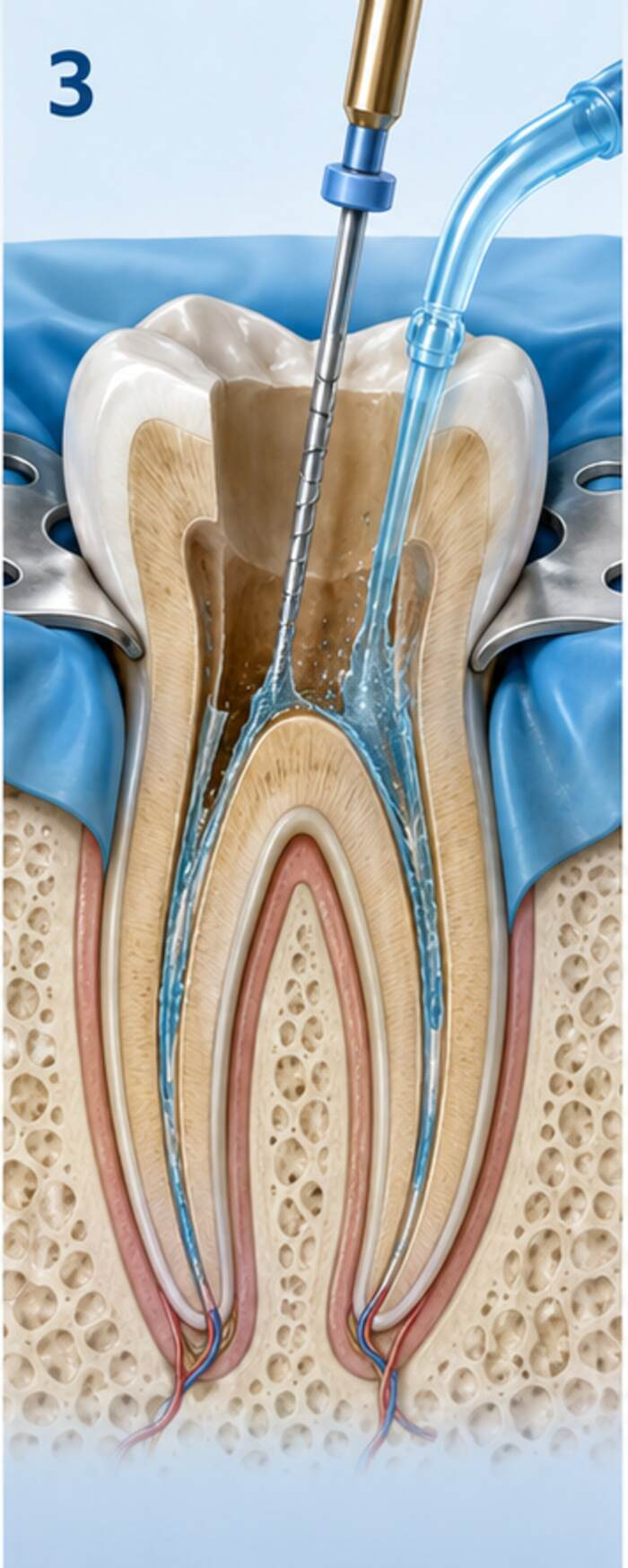
During treatment the canals are rinsed repeatedly with antiseptic solutions. This matters especially because the root canal system has side branches and irregularities that a mechanical instrument cannot reach. After rinsing, the canals are dried with sterile paper points.
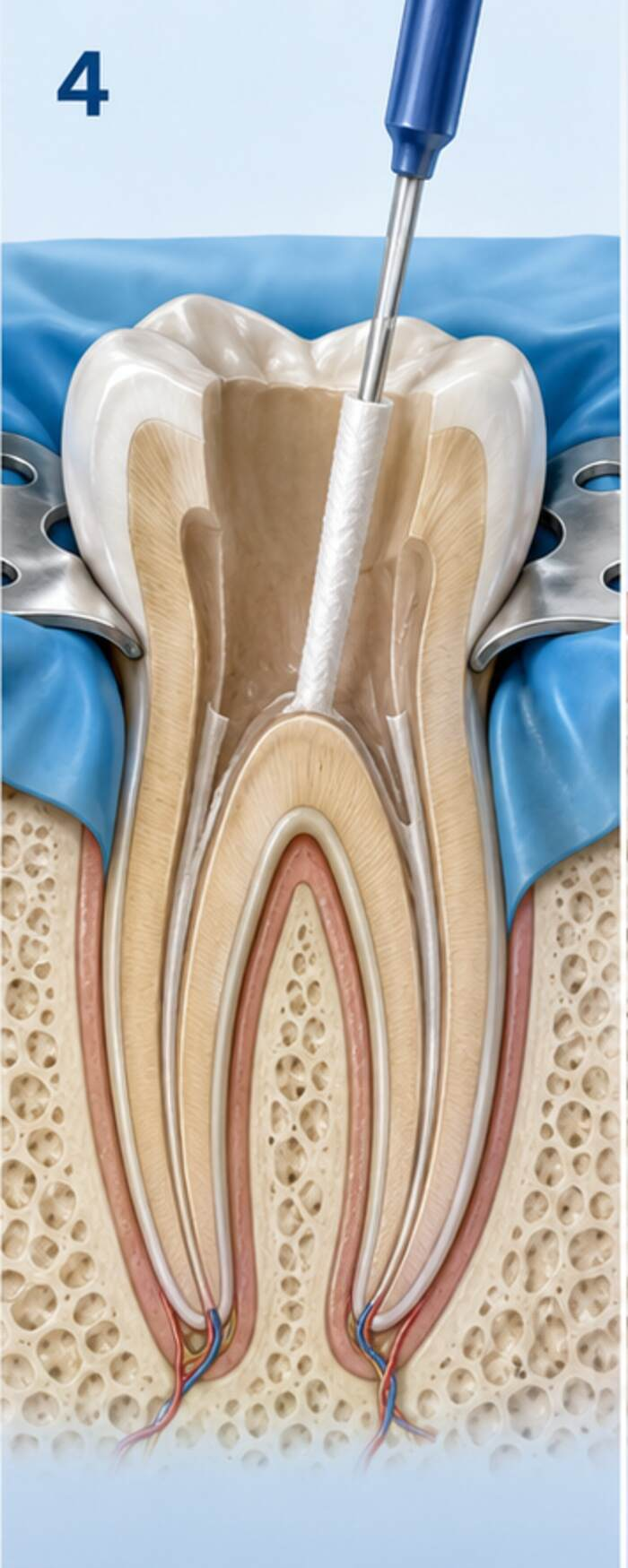
After cleaning, disinfection, and drying, the canals are filled with a special material - most often gutta-percha combined with a sealing cement.
The material must tightly fill the prepared part of the canal up to its working length. After filling, the dentist takes a check X-ray, assesses the density and length of the fill, and then seals the tooth cavity with a temporary or permanent material.
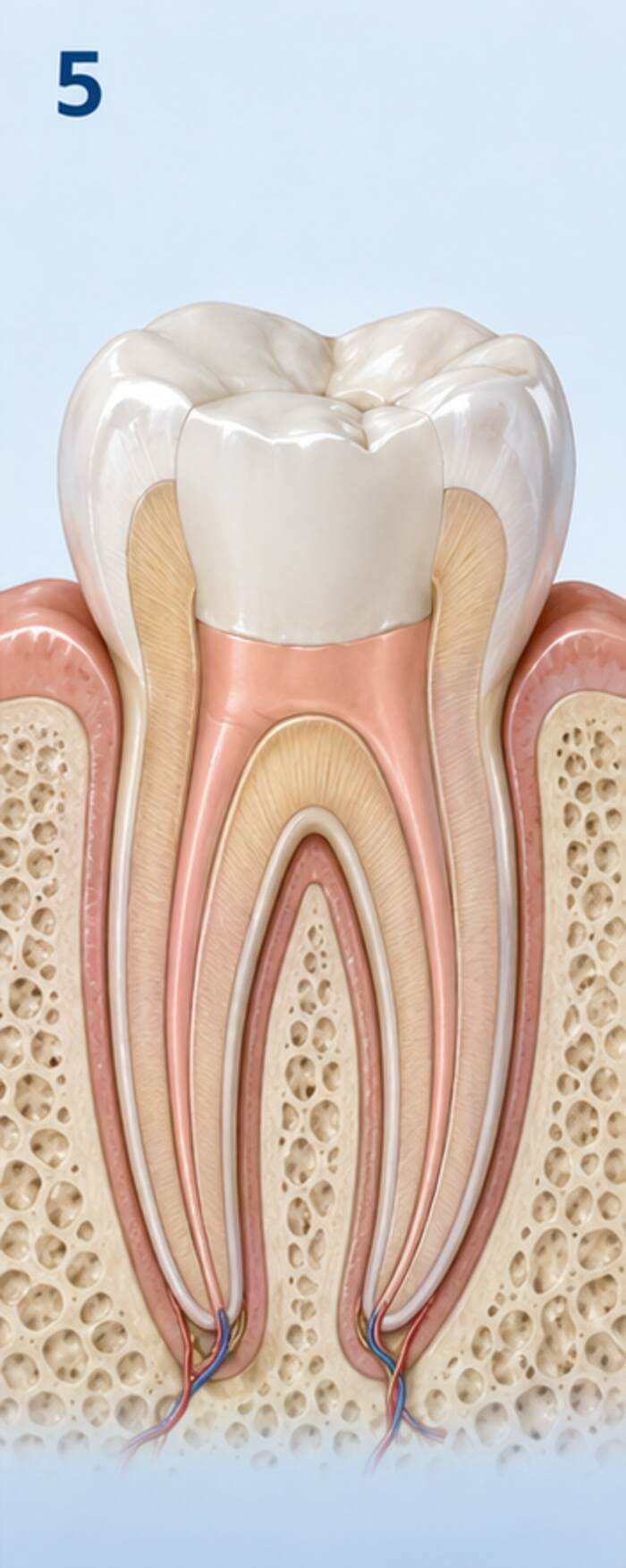
After root canal treatment, the tooth needs to be permanently restored as soon as possible. A small amount of damage can sometimes be closed with a filling. A badly damaged back tooth is usually further protected with an inlay, onlay, or crown to reduce the risk of the remaining walls cracking.
A fully restored tooth can function without its pulp, since the tissues around the root continue to be nourished. However, the quality of the final restoration matters just as much as the quality of the root canal treatment: a leaking filling or crown can let bacteria back in.
Mild discomfort when biting may last a few days after treatment. Increasing pain, swelling, fever, a returning gum boil, or a feeling that the tooth is the first to touch when the jaws close all call for another visit to the dentist.
A filling restores a tooth's anatomical shape, seal, and function after decayed or damaged tissue is removed. A good restoration should protect the inner tissues, withstand chewing forces, not interfere with the bite, and make proper contact with the neighboring tooth.
The material is chosen based on more than price and color. The dentist takes into account the size and location of the defect, how many walls of the tooth remain, the chewing load, the condition of the gums, whether the area can be reliably kept dry, and how it needs to look.
The procedure usually includes the following steps:
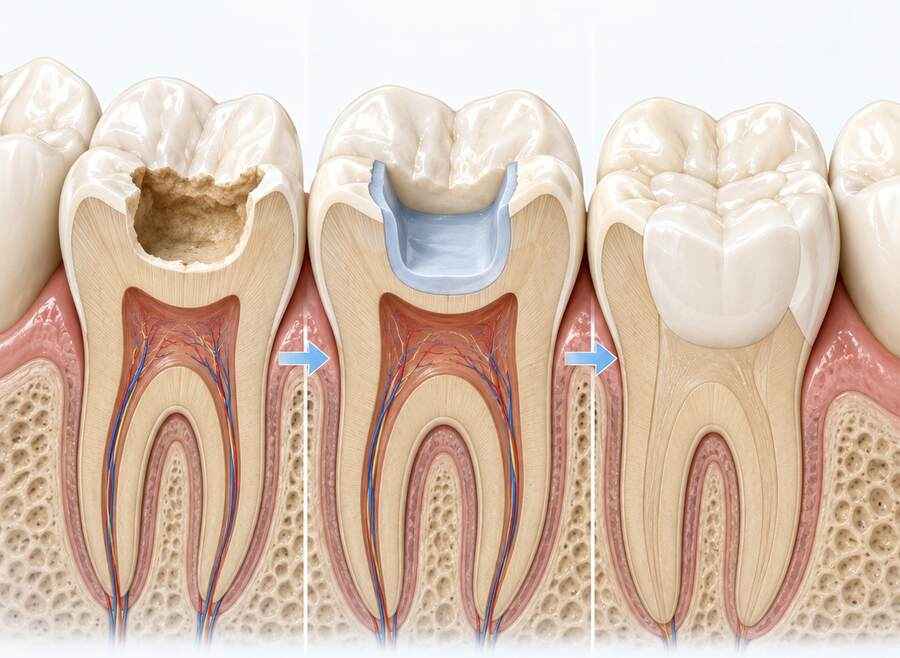
Light-cured composite is applied in small layers. Each layer is cured with a special light.
Advantages of composite:
Drawbacks of composite:
How long it lasts depends on the size of the filling, the tooth's position, the bite, teeth-clenching habits, and the quality of home care.
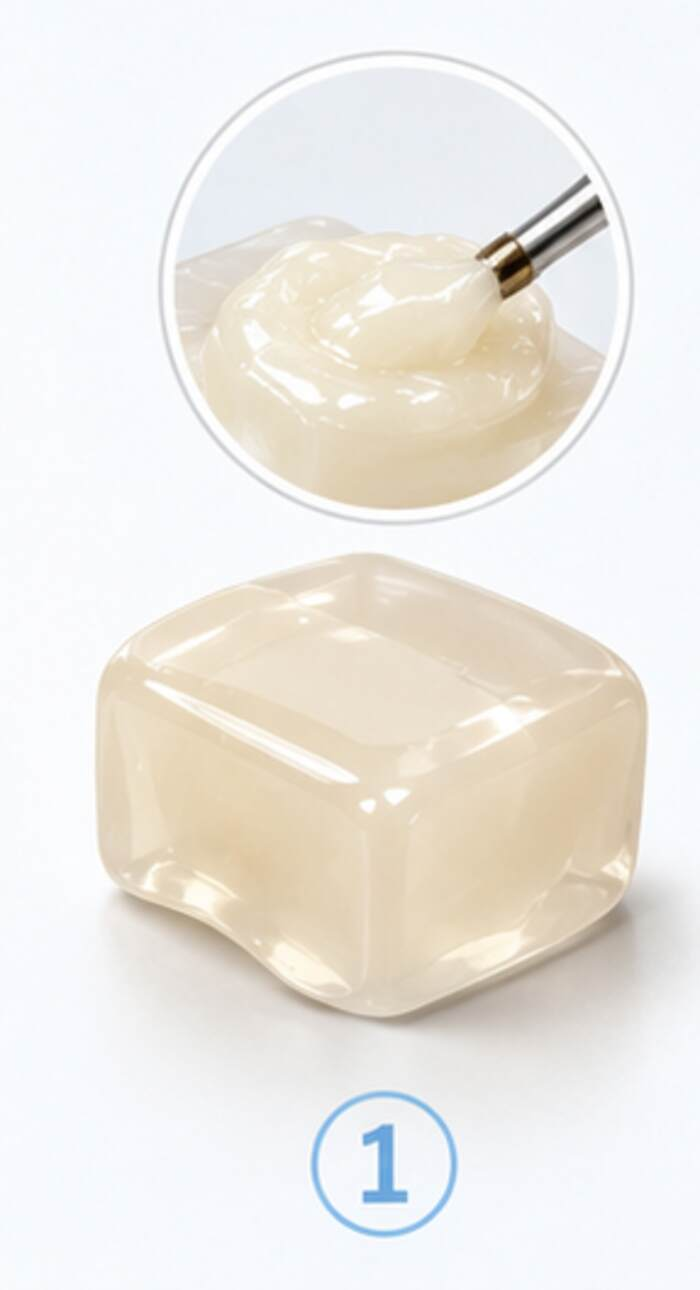
Glass ionomer cement bonds chemically to the tooth and can release fluoride. It tolerates a small amount of moisture reasonably well, which can be useful where perfect isolation is difficult.
It is used for small cavities, defects near the gumline, temporary restorations, treating baby teeth, cementing certain fixtures, and as a base material under other fillings.
Its main limitation is lower strength and wear resistance compared with modern composite or ceramic. So plain glass ionomer cement is not always suitable for large restorations in areas of heavy chewing load.
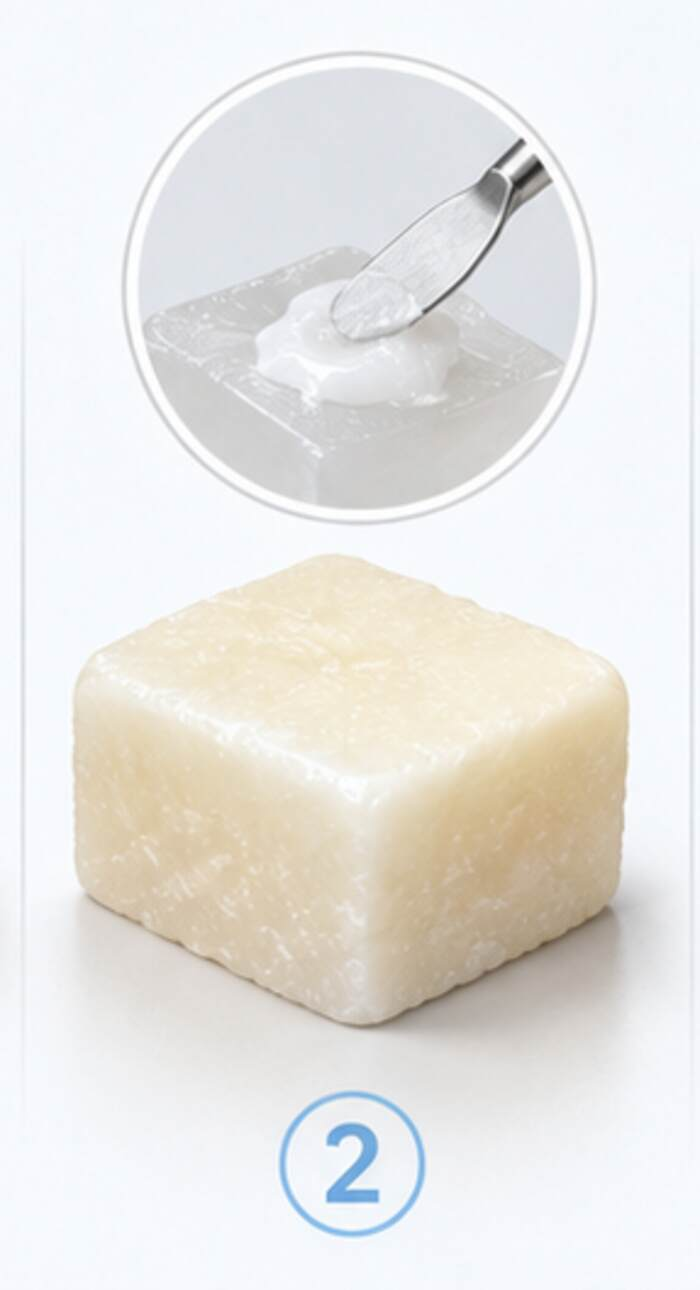
This type of restoration is made separately, from a conventional impression or a digital scan, and then bonded onto the tooth with a special cement.
Advantages of a ceramic inlay or onlay:
A ceramic restoration costs more than a regular filling and requires a lab or digital fabrication step. However, for a badly damaged back tooth, it can be more reliable than a large direct composite filling.
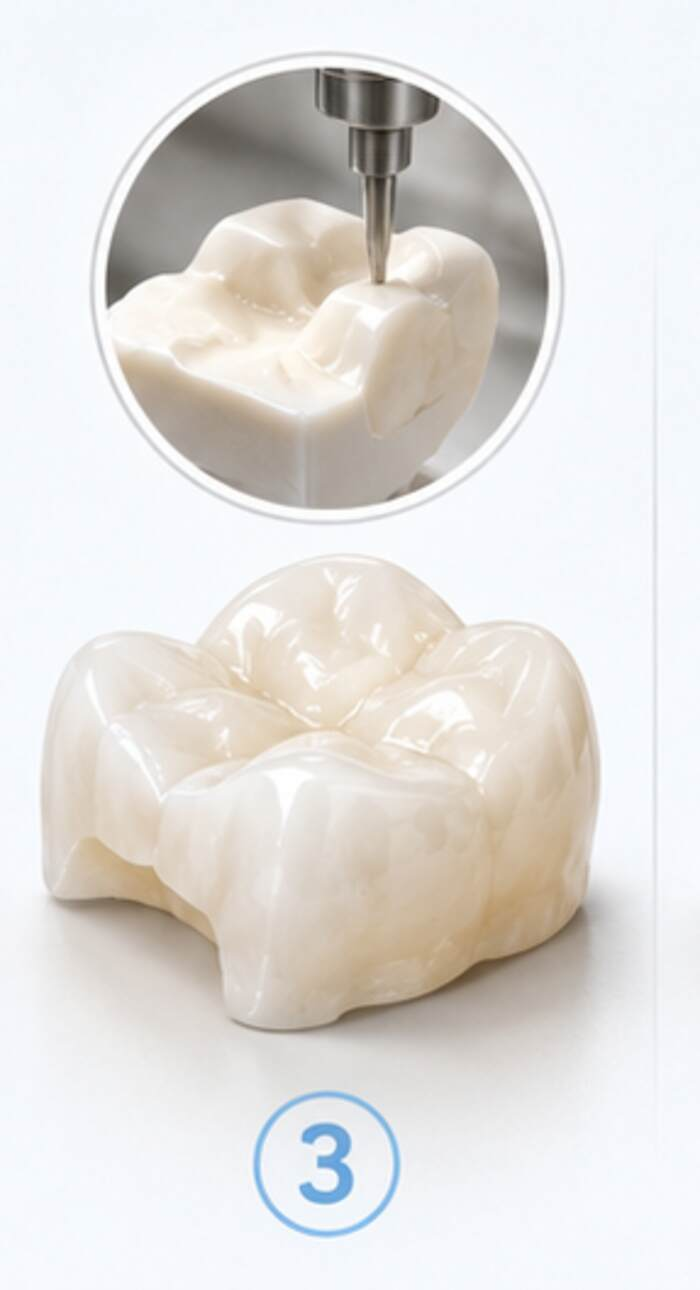
A temporary filling is placed between treatment stages, after medication is applied, during root canal treatment, or to monitor a tooth. It protects the cavity from food, saliva, and reinfection.
Temporary materials are easier to place and remove, but they are not designed for years of chewing load. If a temporary filling falls out, crumbles, or stops sealing properly, contact your dentist and do not delay continuing treatment.
Beyond the materials above, amalgam, metal, and gold restorations also exist. Amalgam is strong and less sensitive to placement conditions, but it has a metallic color and is used less often in modern cosmetic dentistry. Gold inlays are long-lasting and biocompatible, but they are expensive and visible on the tooth.
The choice of material depends on the clinical situation. There is no single filling that is best for every tooth and every size of damage.
A crown is an artificial restoration that fully covers the prepared part of a tooth, restoring its anatomical shape, appearance, and chewing function. It helps spread the chewing load and protects weakened walls from further damage.
A crown may be needed for extensive tooth damage, a large filling, a crack, significant wear, or after root canal treatment. Below is an extended version of the process that includes a post placed inside the canal. A post is not needed in every case and is not fitted automatically after root canal treatment.
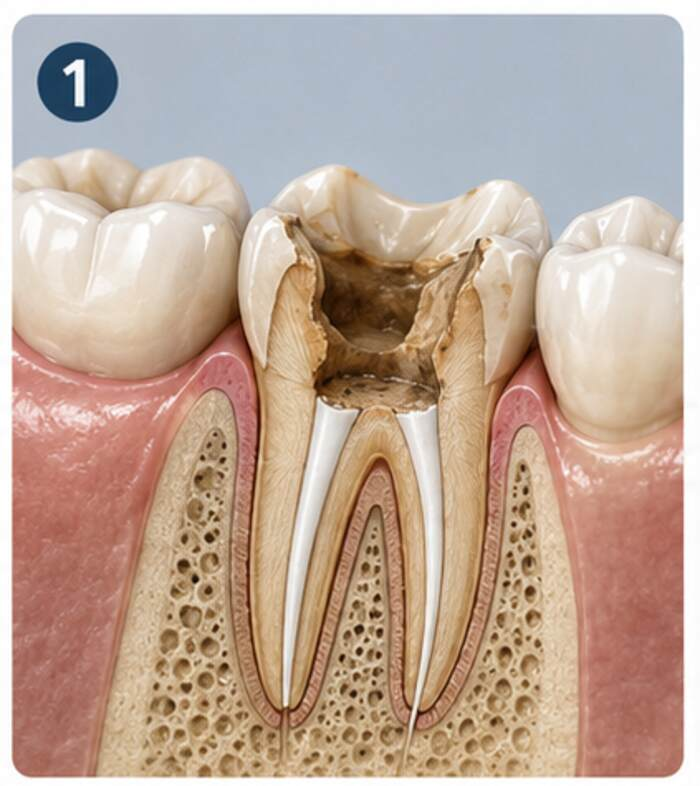
First the dentist assesses whether the tooth can be reliably restored. This includes checking the root, the quality of the root canal treatment, how much tissue remains, where the damaged edge sits relative to the gum, and the condition of the periodontal tissues and surrounding bone.
Root canal treatment or retreatment is carried out if needed. Decayed tissue, leaking fillings, and weakened areas are removed. Sometimes gum treatment or surgical lengthening of the visible crown is needed before the restoration.
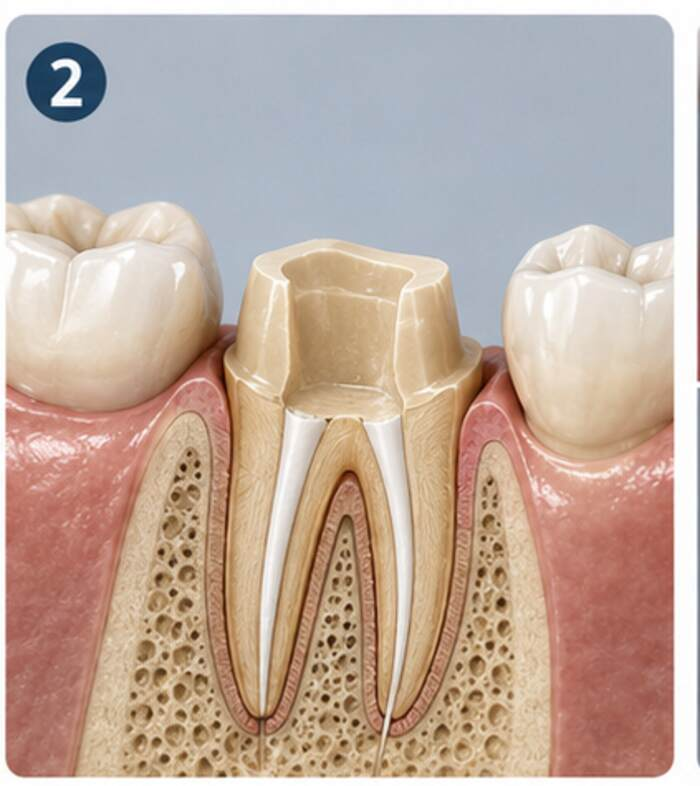
The tooth is trimmed down on all sides, creating even space for the crown material and the right shape for it to be seated. How much is removed depends on the type of crown and the tooth's position.
If enough natural tissue remains, the core is rebuilt with composite material without a post. What matters is not only the height of the core but also having a solid ring of the tooth's own tissue around it. That ring helps the restoration resist chewing forces and lowers the risk of the root fracturing.
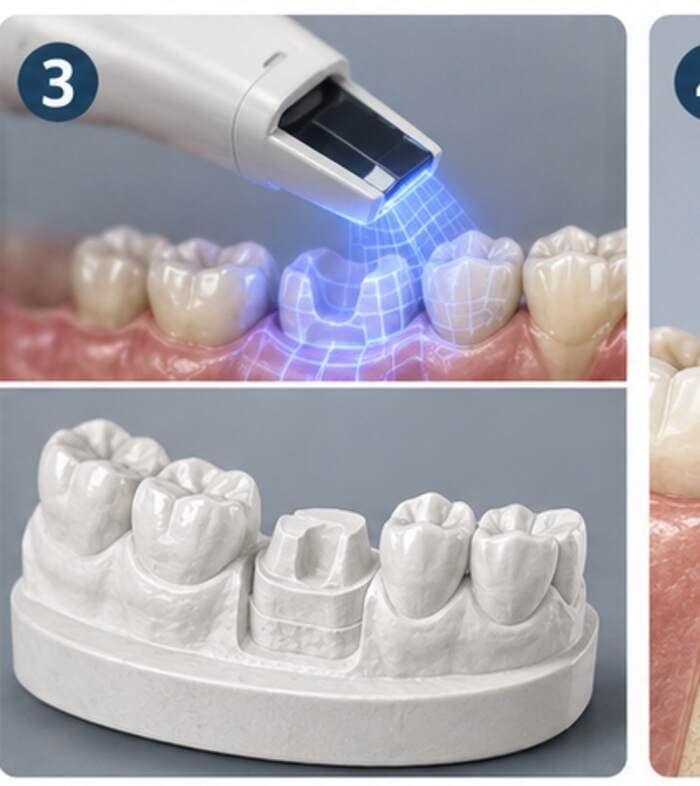
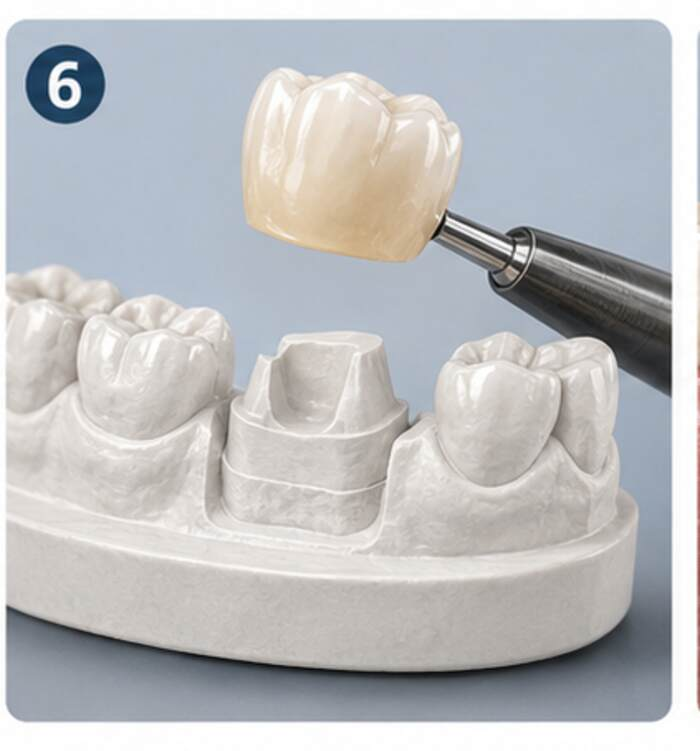
The dentist takes a conventional impression with a special material, or scans the teeth with an intraoral scanner. This captures not only the prepared tooth but also the neighboring teeth, the opposing jaw, the position of the edge near the gum, and the bite relationship.
With the conventional approach, the lab casts a precise plaster model of the jaw from the impression, and a technician sculpts the crown on this model and checks its contacts. With digital technology a virtual three-dimensional model is created instead, so a physical plaster model may not be needed.
A post is used only when there is not enough tooth structure left above the gum to reliably hold the rebuilt core. Its job is to anchor the core part of the restoration. A post does not strengthen the root by itself, and widening the canal too much can actually weaken it.
The dentist clears part of the filled canal while keeping the sealing material intact near the root tip. The length and diameter of the post are chosen to fit. It can be fiber, standard metal, or custom-made together with a core.
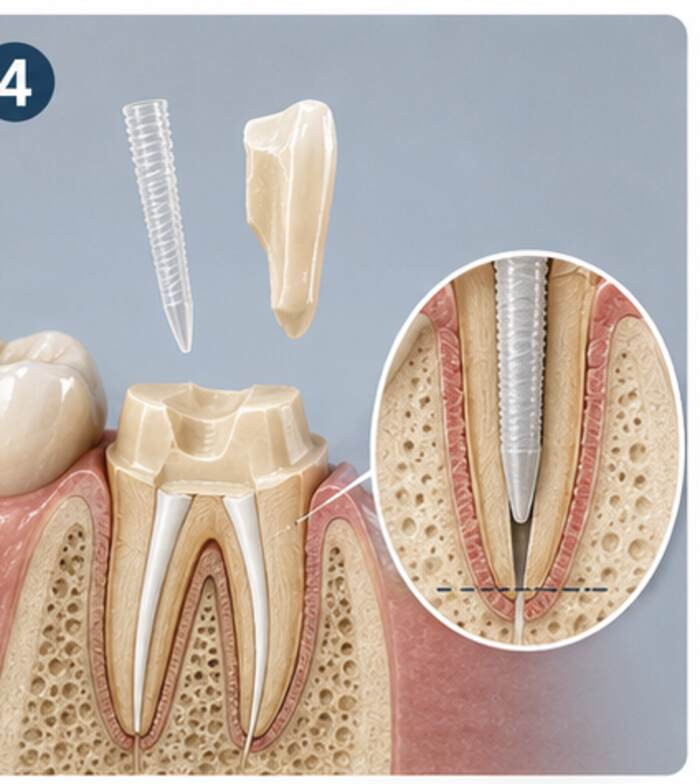
After a trial fit and cleaning of the prepared space, the post is cemented into the canal with a special cement. It must not extend past the tip of the root.
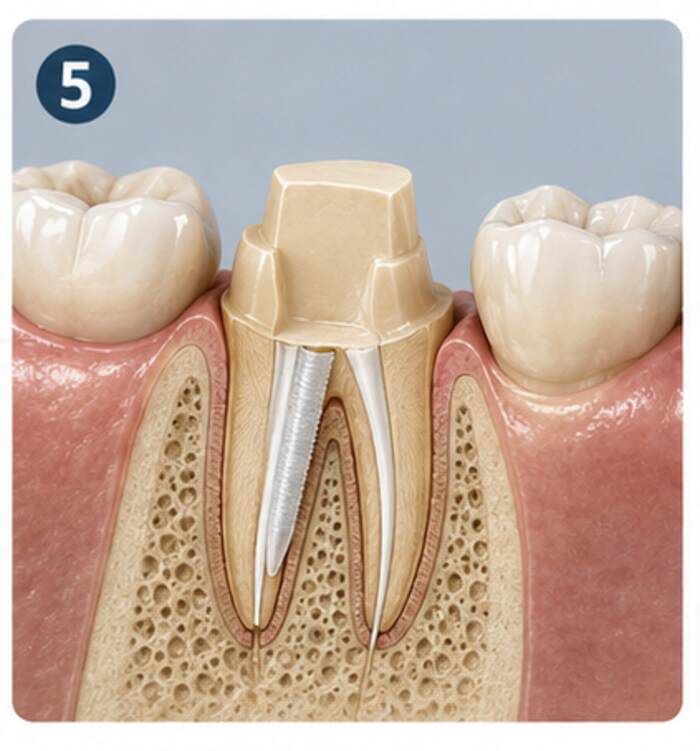
The core, which will support the crown, is built up over the post. Once the material has set, the core is finally shaped, checking that there is enough space and the right path for the future crown to be seated.
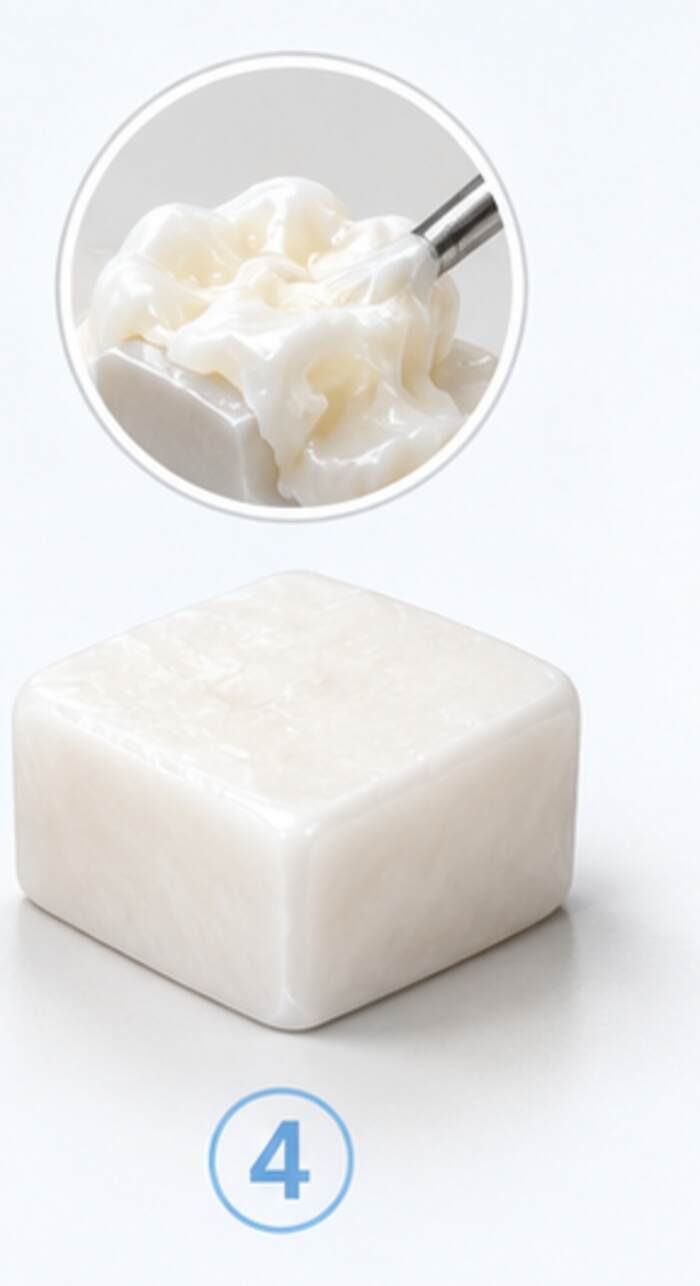
A dental technician or a milling system makes the crown from the chosen material:
The choice depends on the tooth's position, the chewing load, how much tissue remains, appearance requirements, and budget. While the permanent crown is being made, the patient is usually fitted with a temporary one. It protects the core, reduces sensitivity, and keeps the teeth and gums in position.
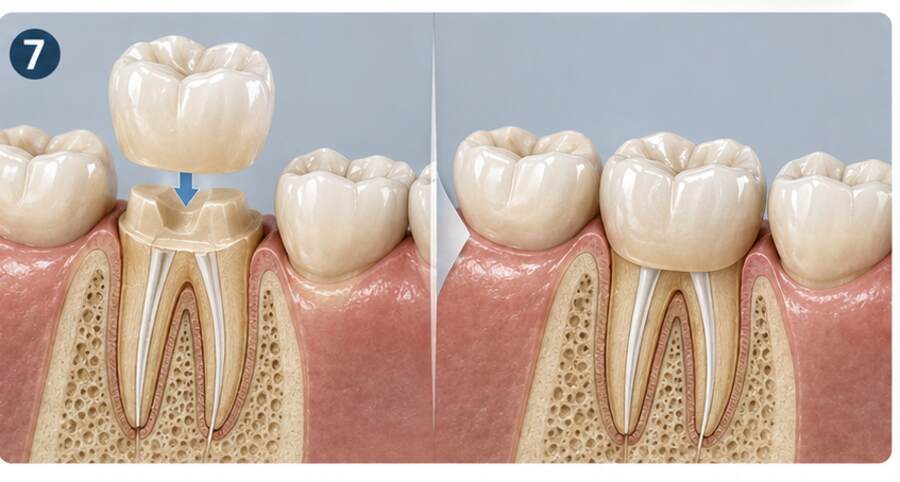
Before cementing the crown, the dentist checks:
After any needed adjustments, the inside of the crown and the core are prepared for cementation. The crown is seated with permanent cement, the excess is removed, and the bite is checked again.
After a crown is fitted, the tooth needs to be brushed just as thoroughly as the others. Cleaning around the gumline and between the teeth matters especially. A crown protects the restored tooth, but decay can still start at its edge, and poor hygiene can still cause gum inflammation.
Tooth pain can be sharp, dull, throbbing, brief, or constant. Its character helps the dentist choose a direction for diagnosis, but the sensation alone cannot pinpoint the cause.
Pain can come from the dentin, the pulp, the tissues around the root, the gum, the tooth's supporting ligament, the chewing muscles, or a nearby anatomical area.
A sharp pain that stops soon after the trigger is removed is often linked to exposed dentin. Possible causes include gum recession, enamel wear, a wedge-shaped defect at the gumline, a small crack, decay, or recent dental treatment.
Treatment depends on the cause and can include desensitizing toothpaste, fluoride treatments, sealing the exposed dentin, a filling, or gum treatment.
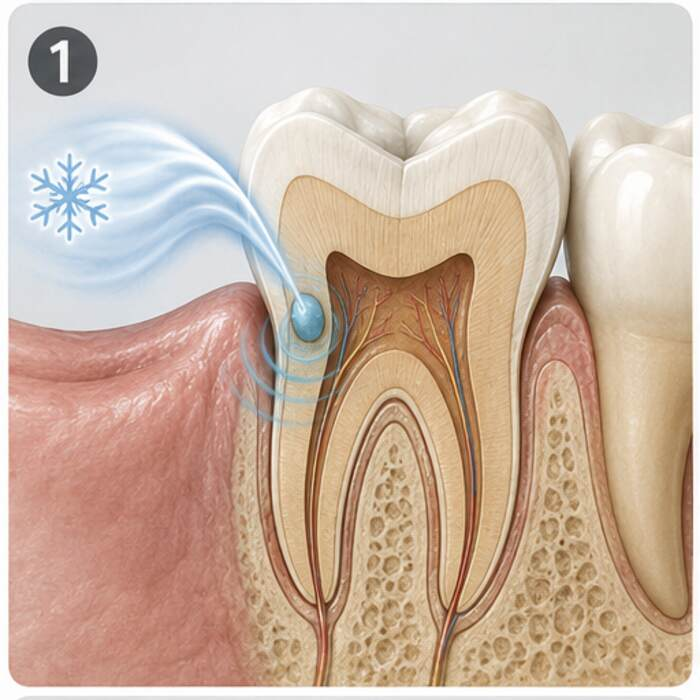
Minor decay may not cause any pain. Once it reaches the dentin, the tooth may briefly react to sweets, cold, heat, or food getting into the cavity.
Treatment does not mean masking the pain - it means removing the affected tissue and restoring the tooth.
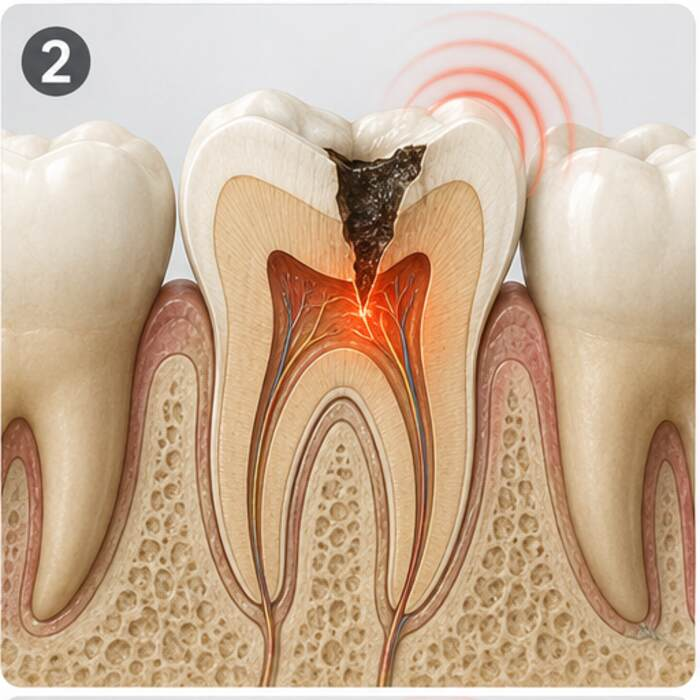
Pain that lingers after hot or cold, appears on its own, gets worse at night, or is hard to pinpoint may be linked to significant inflammation of the pulp.
The dentist assesses whether the pulp is still viable and can be saved. When the inflammation is irreversible, root canal treatment is usually needed.
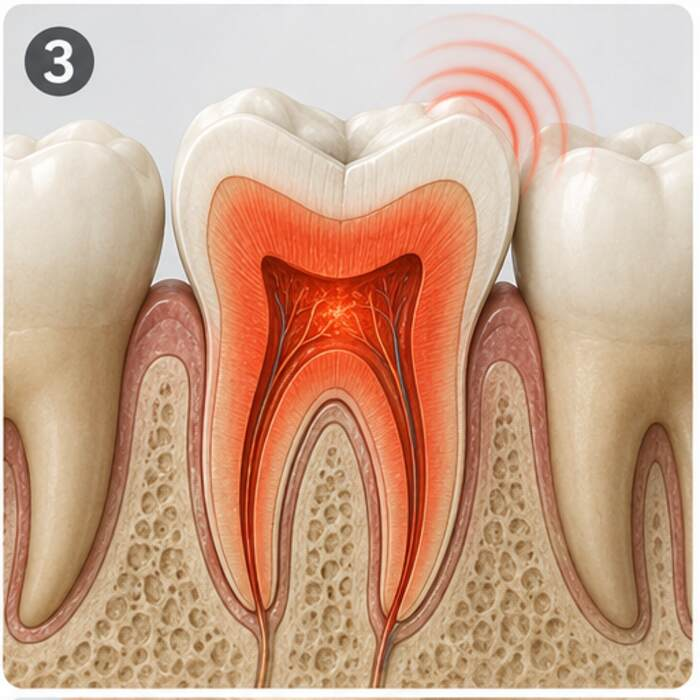
Pain when chewing or when the tooth is tapped can come from inflammation of the tissues near the root tip, a cracked tooth, a filling sitting too high, an injury to the supporting ligament, or gum disease.
A short, sharp pain on biting down or right as the pressure is released is especially typical of a crack. Cracks are not always visible on a regular X-ray.
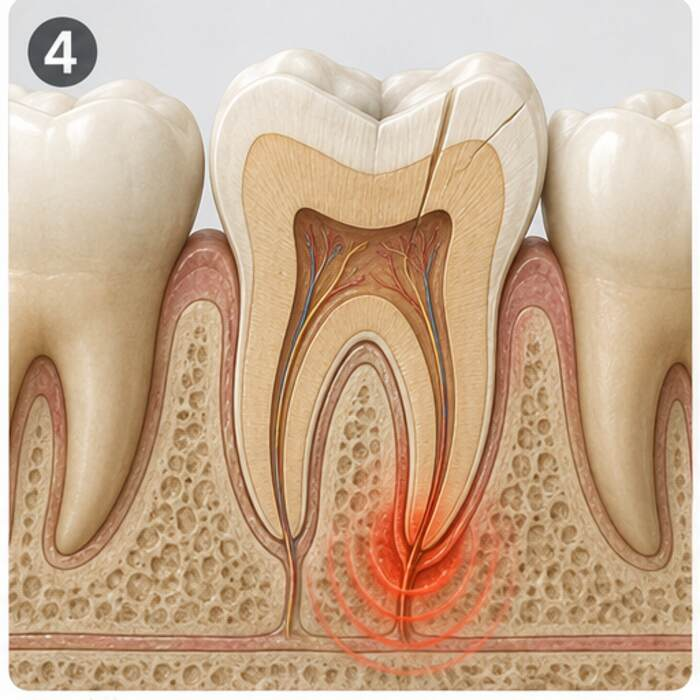
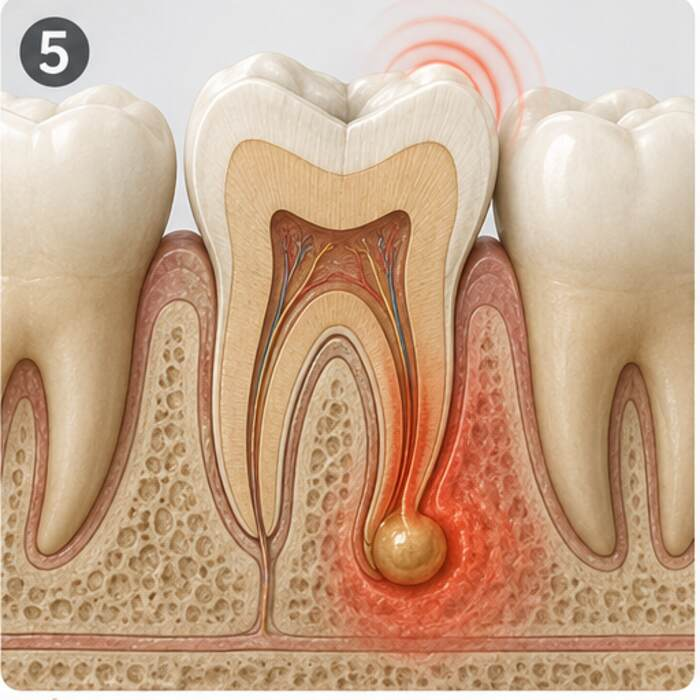
Intense throbbing pain, swelling of the gum or face, a bad taste, fever, and pain when biting can point to an abscess.
This needs urgent dental care. If the swelling spreads toward the eye or neck, or makes it hard to breathe, speak, or swallow, seek emergency medical help.
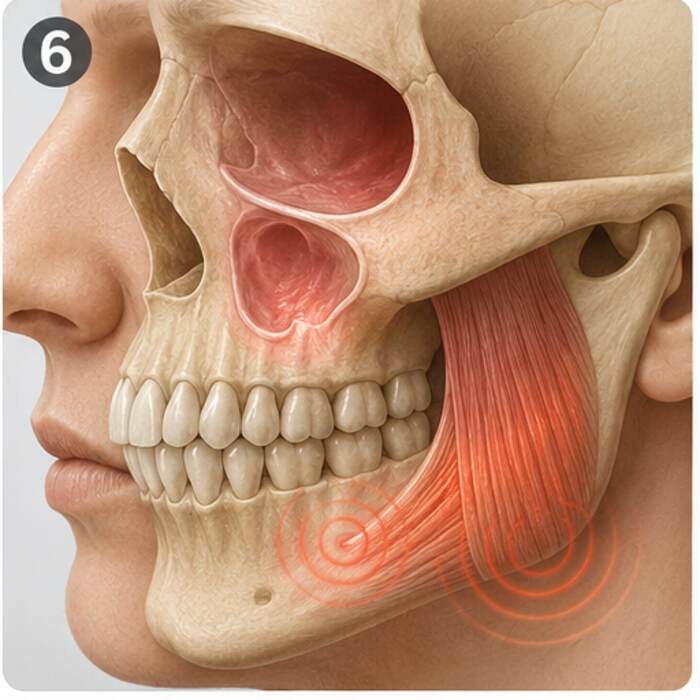
Pain in the upper back teeth is sometimes linked to sinus inflammation. Pain in the teeth and jaw can also come from overworked chewing muscles, teeth grinding (bruxism), or a problem with the jaw joint.
Less often, the cause is a nerve-related or other condition. So when there is no obvious problem in the tooth, the dentist evaluates nearby areas and refers the patient to another specialist if needed.
See a dentist if the pain lasts more than two days, gets worse, does not respond to regular painkillers, or comes with fever, pain when biting, a bad taste, or swelling.
Do not place an aspirin tablet against the tooth or gum, and do not apply heat to swelling. A painkiller may ease the symptom temporarily, but it does not treat the cause.
Tartar is mineralized dental plaque. Soft plaque can be removed with a toothbrush and interdental cleaning tools. Once it hardens into tartar, it can no longer be removed reliably at home - that requires a professional cleaning.
A sticky bacterial film constantly forms on the surface of the teeth. It builds up especially near the gumline, between teeth, and around crowded teeth, crowns, implants, and orthodontic appliances.
If plaque is not removed regularly and thoroughly, the bacteria irritate the gum and cause inflammation.
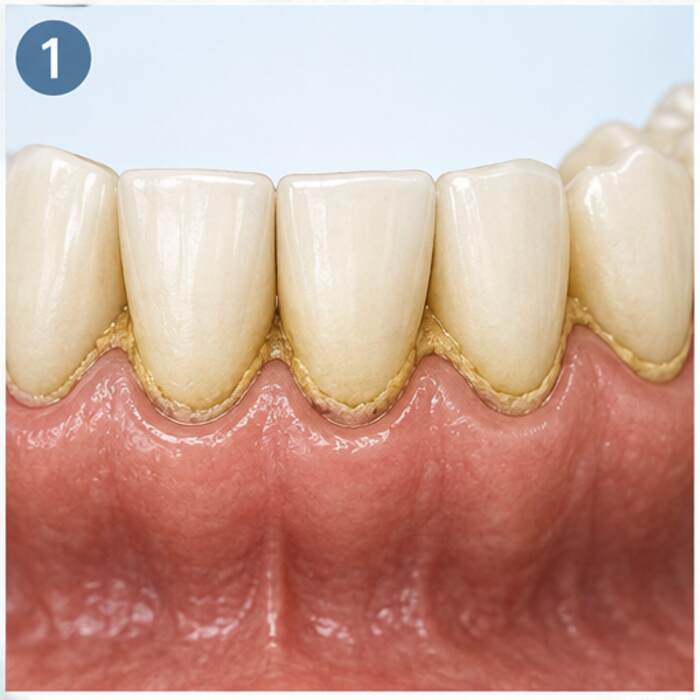
Minerals in saliva gradually soak into soft plaque and it hardens. How fast tartar forms varies from person to person.
Main contributing factors:
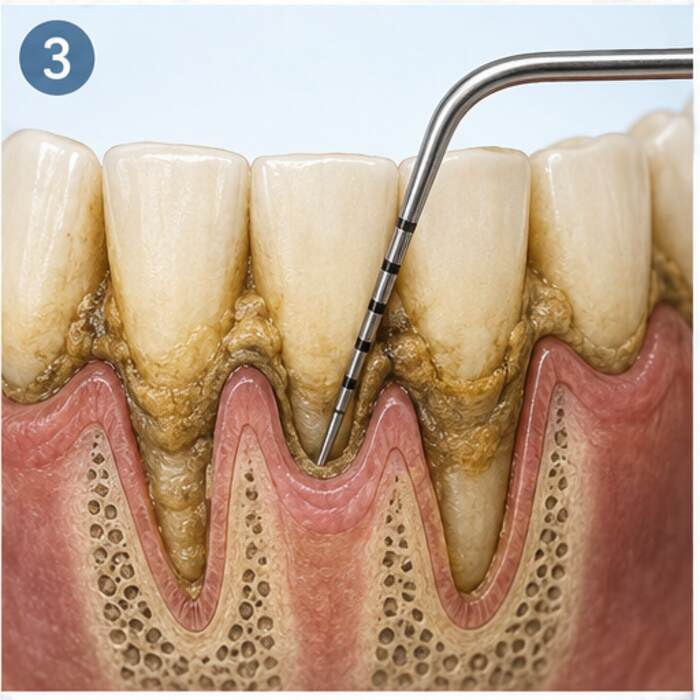
Tartar can be above or below the gumline. Deposits below the gumline sit inside the periodontal pocket and may not be visible during an ordinary look in the mirror.
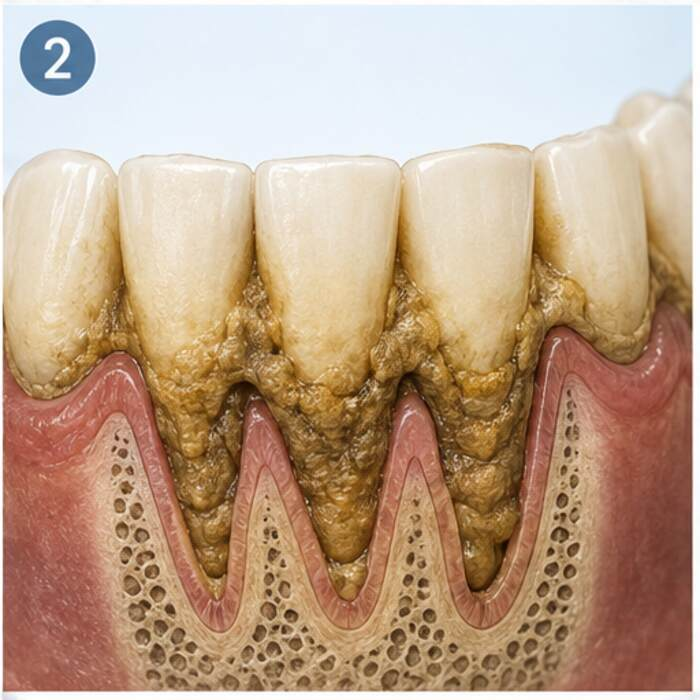
The dentist or hygienist assesses how much tartar there is and where it sits, along with the condition of the gums, fillings, crowns, and implants.
If there are signs of gum disease, the depth of the periodontal pockets is measured. X-rays may be needed if bone damage is suspected.
A routine preventive cleaning and a deep periodontal treatment are not the same procedure. How deep and extensive the treatment is depends on the condition of the tissues.
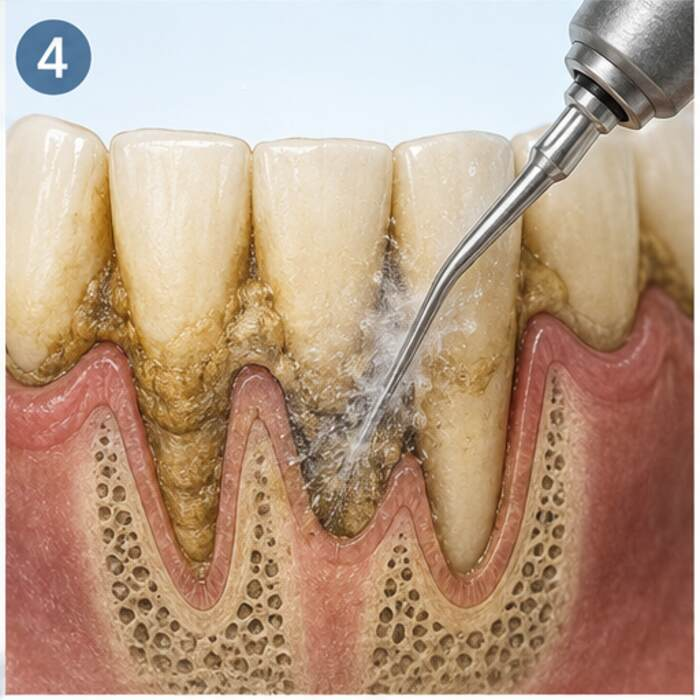
An ultrasonic scaler vibrates its tip rapidly to break down hard deposits. Water is delivered at the same time to cool, rinse, and wash away particles.
The tip is moved along the tooth surface. It should never be used like a drill to grind down enamel.
For sensitive teeth, inflamed gums, or deeper treatment, the dentist may use local anesthesia.
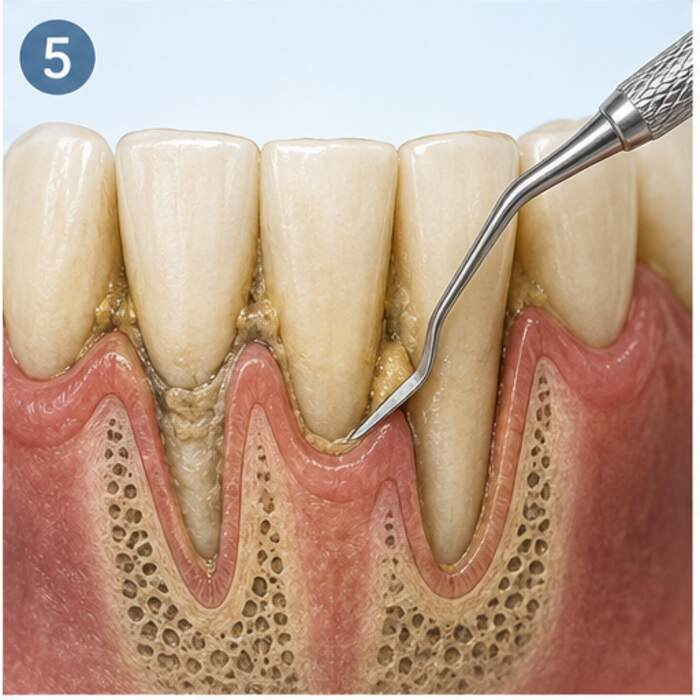
Remaining deposits are removed with hand instruments. In cases of periodontitis, the dentist cleans the root surface below the gumline and smooths the affected surface if needed.
After tartar removal, the teeth are polished with a brush or a rubber cup and a professional paste. Stained soft plaque may be removed further with an air-polishing device.
Polishing does not whiten the tooth's underlying color, but it removes surface staining and leaves a smoother surface.
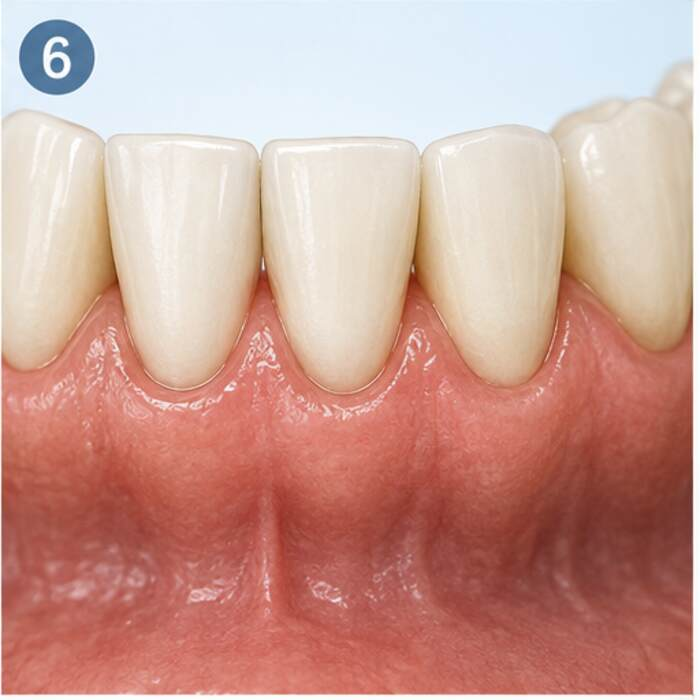
Removing plaque and tartar reduces the amount of bacteria near the gum, helps stop gingivitis, and reduces bleeding and bad breath. In periodontitis, a deep cleaning is part of treating the infection and helps slow the breakdown of the tissues that hold the tooth in place.
Brief sensitivity, mild bleeding, or gum tenderness are possible after the procedure. As inflammation and swelling go down, teeth can sometimes look longer and the gaps between them more visible. That does not mean the cleaning has worn the teeth down.
What patients who have been with us for years say.
I had an implant placed - everything was explained calmly, the plan and timeline laid out in advance, no surprises. It healed without any issues and feels just like my own tooth.
Borys Anatoliyovych made my crowns. Done quickly, no dragging out the timeline, they fit perfectly. You can tell the man has been in his place for many years.
I bring both my kids here. The younger one was scared of dentists, but here they talked to him without rushing - and now he goes without tears. For us that's decisive.
Had a root canal - they laid out the plan and cost honestly in advance, no surprises at the end. Fair prices, nothing unnecessary pushed on me.
I've been treated here for over ten years. The same doctors, who remember me and my teeth. They treat you like a person, not patched up - next.
Learn more about dentistry

It withstands strong chewing loads but cannot self-repair. That's why prevention is more important than treatment.

The patient with an early titanium implant lived with it for over 40 years. Today implantation is one of the most reliable procedures.

Baby teeth buds form during fetal development. Mother's health directly affects the child's dental system.

Thanks to microscopes and digital diagnostics, doctors can now save even heavily damaged teeth that used to be extracted.

Like fingerprints, the shape and position of teeth are unique. They are sometimes used for identification.

Inside the tooth is the pulp with nerves. When inflammation reaches it, the pain becomes sharp and unbearable.

The first US president left records of buying teeth. His dentures were made of gold, ivory, and human teeth.

In zero gravity you can't spit, so astronauts use edible toothpaste that can be swallowed.

Researchers discovered regeneration mechanisms similar to sharks. Methods to grow new teeth are being developed.

The record was set in Germany, and later in India a tooth about 39 mm long was extracted.

The earliest traces of dental treatment were found in modern-day Slovenia.

His dentures included spring mechanisms to help open the mouth, but they could trigger unexpectedly.
Book by phone - the receptionist will find a convenient time for you.